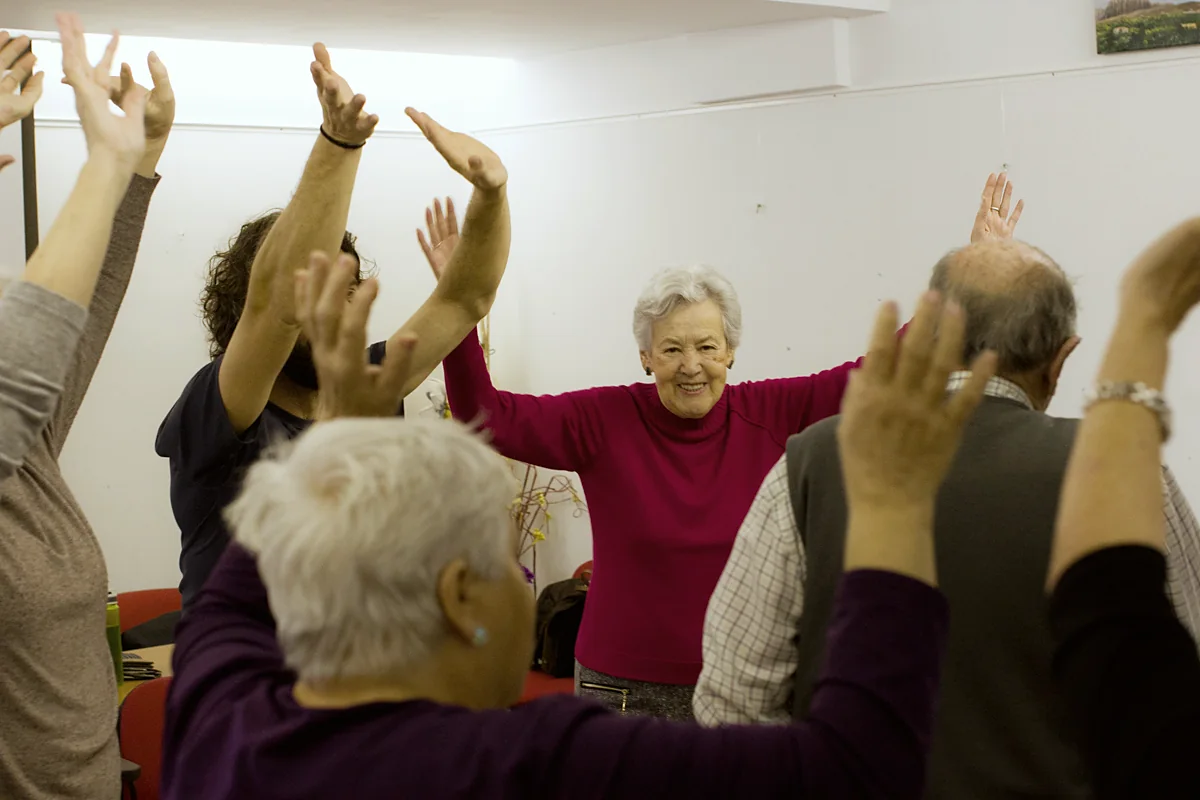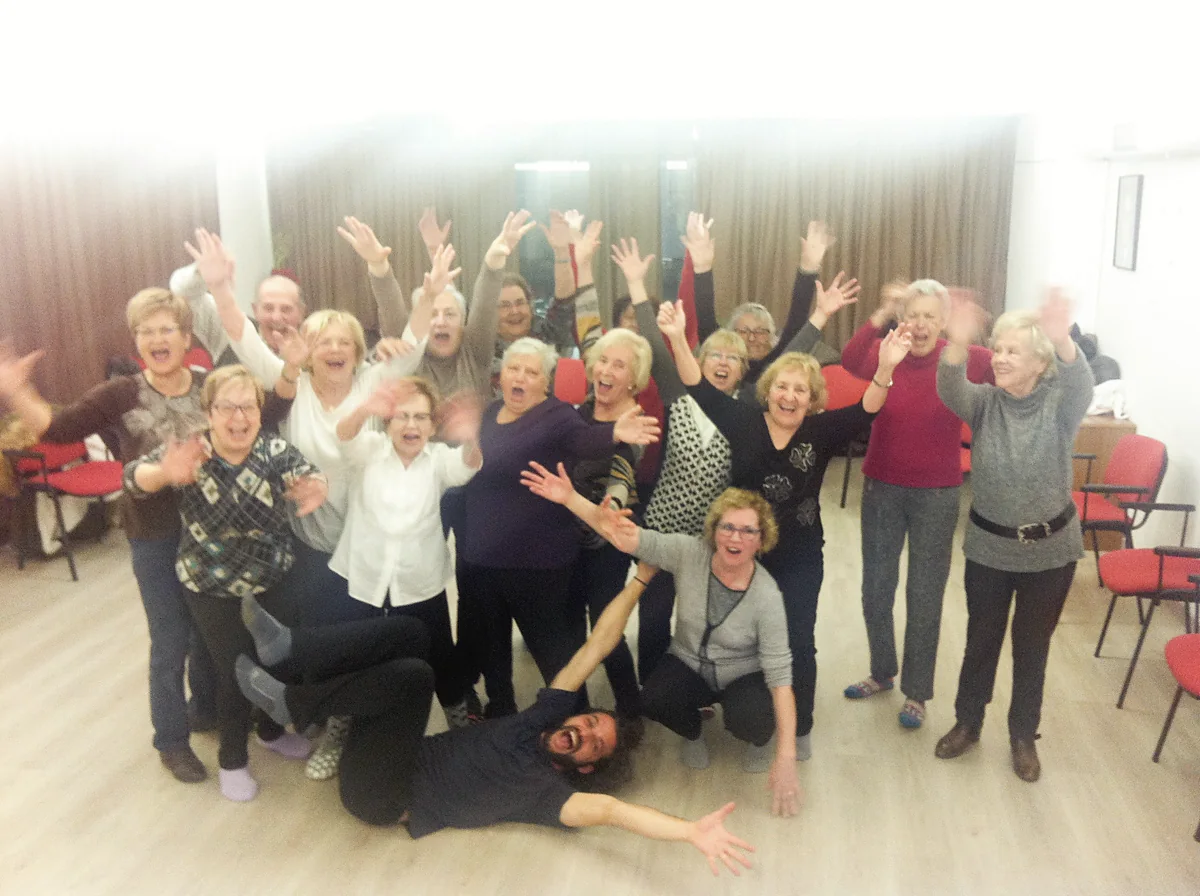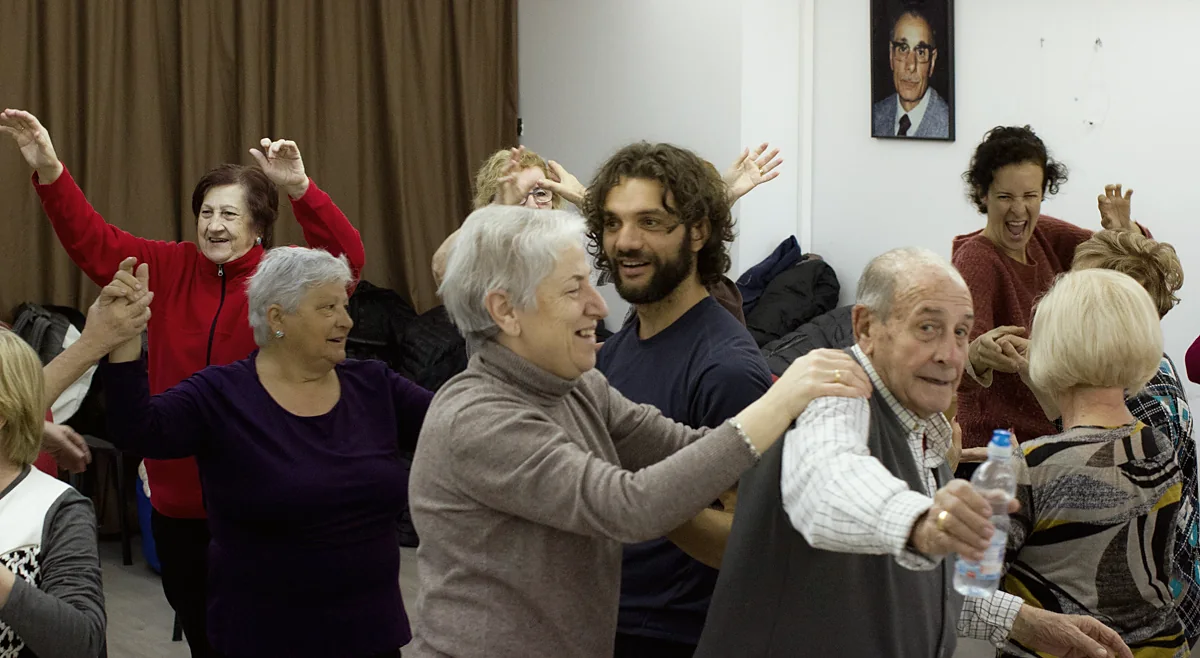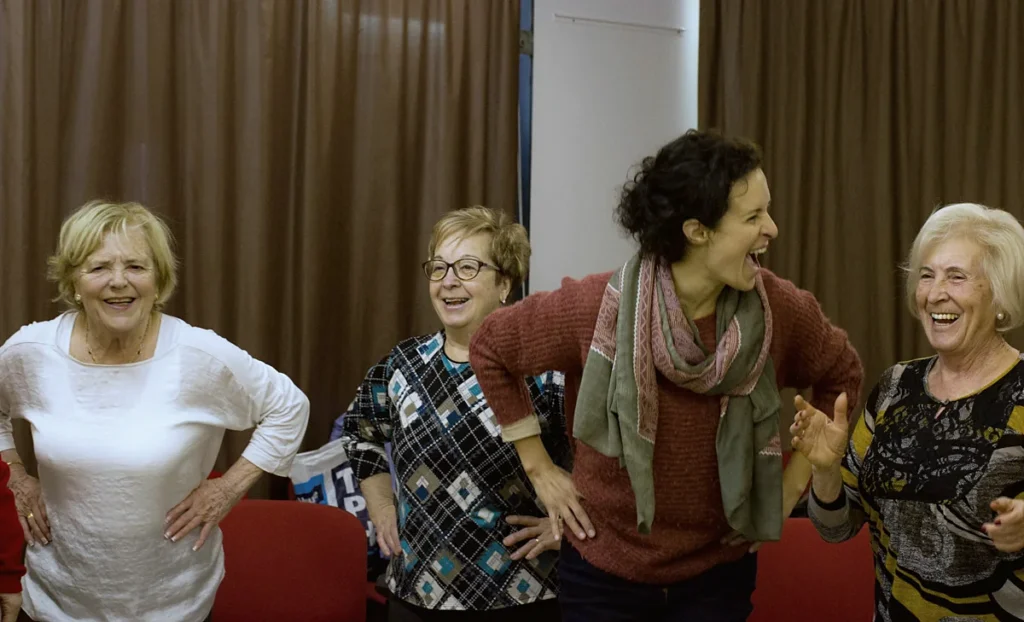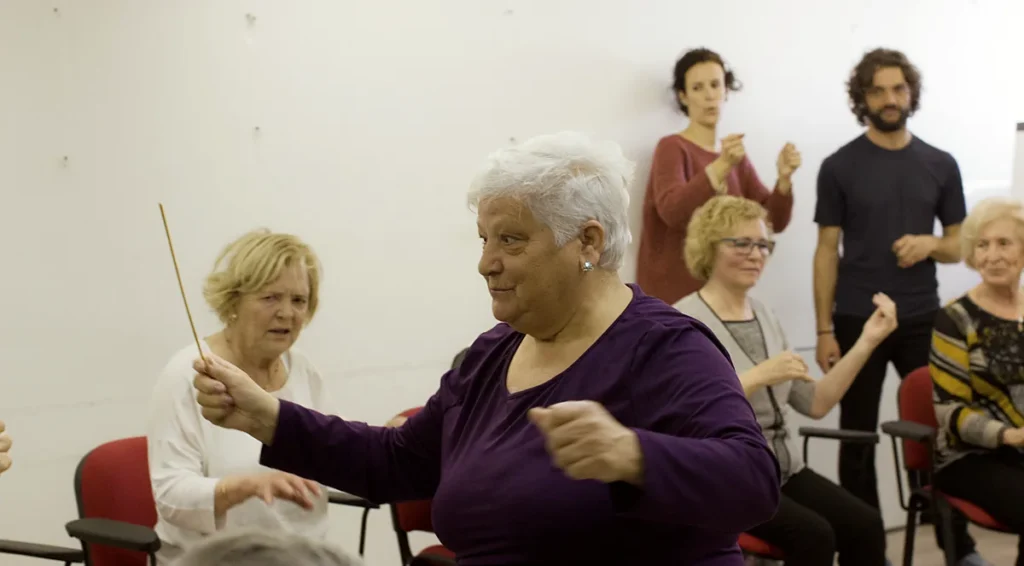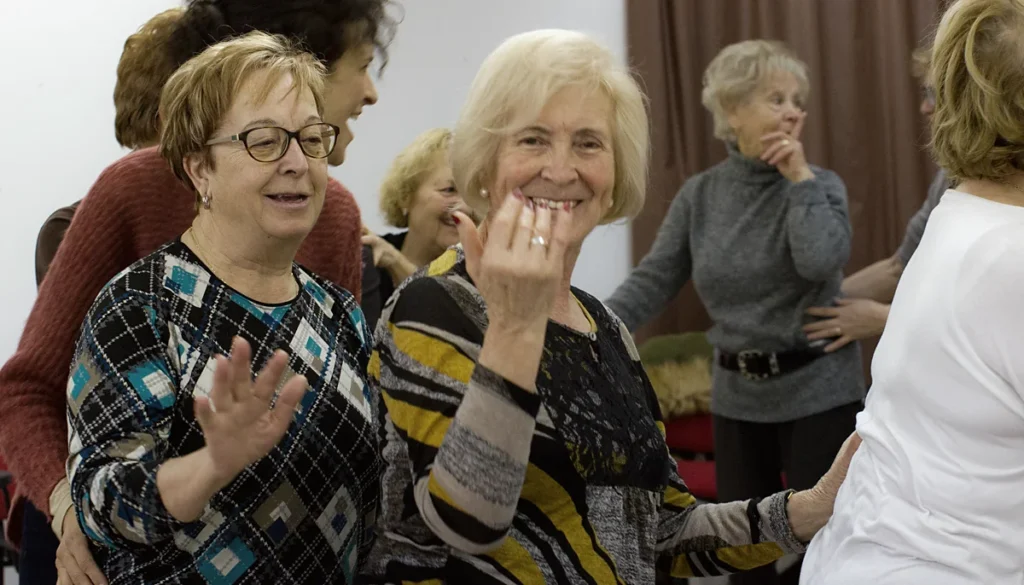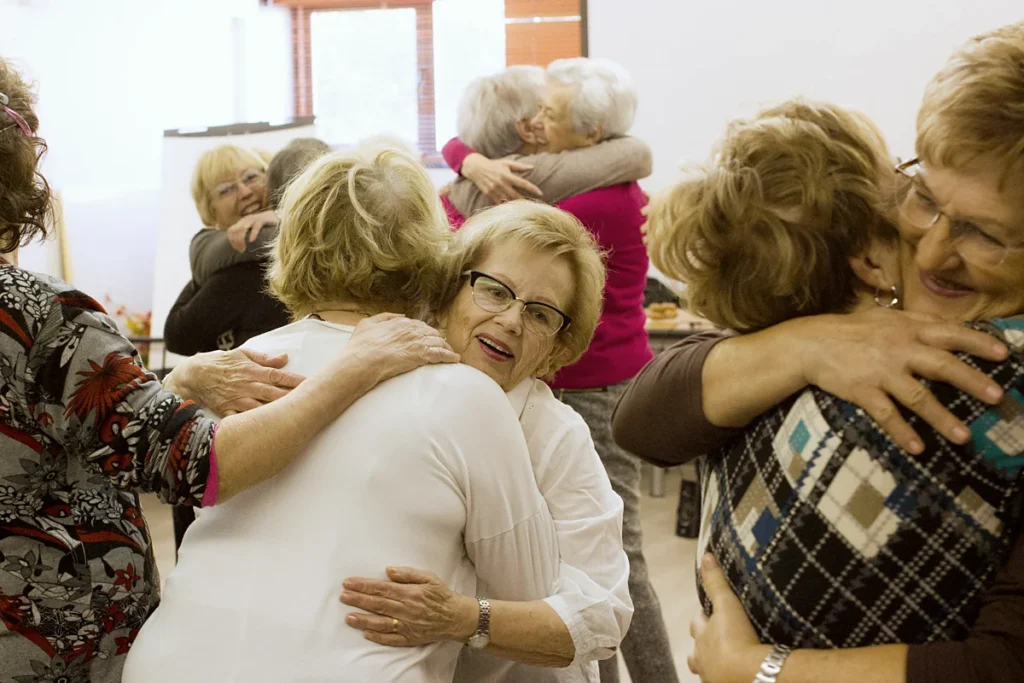


Group of older people with their arms up in a Laughter Therapy workshop Final group photo with arms up after a Laughter Therapy workshop with older people Red Lúdica facilitator among a group of older people greeting each other

Articles · Older people

Laughter Therapy activities for older people: 12 step-by-step ideas

Twelve play, music and laughter activities for care homes, day centres and community groups, organised by moment in the session. All can be done seated, with adaptations for each group and free printable guides.

By José Eduardo, Red Lúdica facilitator · 14-minute read · November 2026

Before you start

Three questions to get it right

Every group of older people is different. Before choosing activities, answer these.

What is the group like?

If most people use a wheelchair or have limited mobility, start with voice, face and hands. If there is energy, add dancing and the stage.

Is there cognitive impairment?

Choose copying games and familiar music, with few instructions. Repeating the same games every week builds confidence.

How much time do you have?

With 30 minutes, one activity per moment. With 45 or 60, two per moment and breaks for a drink of water.

The activities

12 activities, four moments

Two featured activities per moment and one more in the guides. Each guide includes preparation, steps and adaptations for wheelchair users, cognitive impairment and hearing loss.

1

To begin

Greet each other, wake up the body and ease into play.

Red Lúdica facilitator laughing with a group of older women

The circle greeting

Sitting in a circle, each person says their name and greets the group in their own way: a wave, a wink or a bow. The whole group greets them back at once.

6 to 25 people · 10 min · No materials

The key: the group returns every greeting with energy. Everyone should feel welcome from the very first minute.

Waking up the body from the chair

Seated, the group stretches as if getting up in the morning: arms up, hands shaken out, a big yawn and a gentle massage of the face and shoulders.

6 to 30 people · 10 min · Stable chairs

The key: each person only moves what feels comfortable. Invite, never correct.

Guide 1 · Step by stepThe circle greeting

What it’s for: Build the group, remember names and give everyone a moment in the spotlight without putting them on the spot.
Group, time and materials: 6 to 25 people · 10 min · No materials

Preparation
  • Arrange the chairs in a circle, with no tables in the middle.
  • Sit in the circle yourself, at the same height.
  • Keep a list of names in case someone forgets their own or someone else’s.
Adaptations
  • Wheelchair users: the whole game is played seated; arm, head and face gestures count just the same.
  • Cognitive impairment: offer two greetings to choose from and say each person’s name with them.
  • Hearing loss: face the person, speak slowly and pair each name with the gesture.
Step by step
  1. Start yourself: say your name and greet everyone with a big gesture, such as a wave.
  2. Ask the group to greet you back all together, using your name: “Good morning, Rose!”.
  3. Go round the circle: each person says their name and chooses their greeting.
  4. If someone doesn’t want to invent one, they can copy the greeting of the person next to them.
  5. Second round, faster: just the gesture, and the group says the name.
If it doesn’t take offIf the group is flat, exaggerate your greeting and ask for a round of applause for each person: applause lifts the energy.

No materials needed. Download the guides (PDF)

Guide 2 · Step by stepWaking up the body from the chair

What it’s for: Gently activate the body, release tension and warm up the voice for laughter.
Group, time and materials: 6 to 30 people · 10 min · Stable chairs

Preparation
  • Check that the chairs are stable and, if possible, without wheels.
  • Ask the staff if anyone has a movement limitation you should know about.
  • Play some calm, familiar music in the background.
Adaptations
  • Wheelchair users: all movements use the arms, hands and face.
  • Cognitive impairment: do each movement in front of the group and wait for them to copy; no need to explain.
  • Pain or limited mobility: moving the hands and face is enough; the yawn is just as contagious.
Step by step
  1. Suggest “waking up” like in the morning: stretch your arms up and give a big yawn.
  2. Shake your hands as if they were wet, gently at first and then fast.
  3. Face massage: rub your cheeks, forehead and ears with your fingertips.
  4. Shoulders up to your ears, hold for a moment and drop them with an “aaah!”.
  5. Finish with a big stretch and a smile to the person next to you.
If it doesn’t take offIf someone doesn’t want to move, invite them to do just the yawn. That is often enough to get them laughing.

No materials needed. Download the guides (PDF)

Guide 3 · Step by stepFaces on the clap

What it’s for: Play with facial expressions and spark laughter by seeing the rest of the group’s faces.
Group, time and materials: 6 to 30 people · 10 min · Face cards

Preparation
  • Use a loud clap or two wooden sticks to mark each change.
  • Print the face cards: joy, surprise, pretend anger, sleepy, fright and pride.
  • Seat the group in a circle so everyone can see each other.
Adaptations
  • Wheelchair users: it is a face-only game, everyone takes part equally.
  • Cognitive impairment: use just a few faces and repeat them; the card helps more than the word.
  • Sight loss: say the emotion out loud and make the sound that goes with it.
Step by step
  1. Explain: “Every time you hear the clap, we change our face and freeze”.
  2. Show a card, for example surprise, and clap.
  3. Ask everyone to look around without changing their face: this is usually where the laughter starts.
  4. Repeat with other cards, a little faster each time.
  5. Last round: everyone chooses their favourite face.
If it doesn’t take offIf people feel shy, start with easy faces (a smile, surprise) and do the most exaggerated ones yourself.

Materials in the printable guides: Face cards. Download the guides (PDF)

2

Rhythm and voice

Music, clapping and vowels: what works best with almost any group.

Older participant keeping the rhythm while seated, with the facilitators behind

The conductor’s baton

One person takes the baton and conducts a familiar piece of music; the group follows by clapping, tapping their feet or patting their knees. Then the baton passes to someone else.

6 to 30 people · 15 min · A baton and music

The key: whoever holds the baton is in charge. Being the conductor for a minute lifts anyone’s spirits.

The vowel choir

The group sings a very well-known song using only one vowel: first A, then E, I, O and U. With I and U, laughter is guaranteed.

6 to 40 people · 10 min · Vowel cards

The key: choose a song everyone knows. The words disappear, leaving the melody… and the laughter.

Guide 4 · Step by stepThe conductor’s baton

What it’s for: Bring the group together through music and give each person a moment in the spotlight.
Group, time and materials: 6 to 30 people · 15 min · A baton and music

Preparation
  • Prepare three or four songs with a clear beat that the group knows: waltzes, swing, songs from their youth.
  • Bring a baton, a wooden spoon or a big pencil.
  • Ask the staff what music the group enjoys.
Adaptations
  • Wheelchair users: hands and knees; feet are optional.
  • Cognitive impairment: familiar music helps a lot; look and smile more than you explain.
  • Hearing loss: turn the volume up with care and mark the beat with very visible gestures.
Step by step
  1. Start with the baton yourself: beat time with big movements.
  2. The group follows the rhythm by clapping, patting their knees or tapping their feet.
  3. Change the speed or stop suddenly: whoever keeps clapping sets off the laughter.
  4. Pass the baton to someone else and let them conduct in their own way.
  5. At the end, a round of applause for every conductor.
If it doesn’t take offIf nobody wants the baton, offer it to whoever followed the beat best and conduct together, four hands on the baton.

Materials in the printable guides: Song list. Download the guides (PDF)

Guide 5 · Step by stepThe vowel choir

What it’s for: Work on voice and breathing, and laugh at how it sounds.
Group, time and materials: 6 to 40 people · 10 min · Vowel cards

Preparation
  • Choose a very popular, short song, such as “Happy Birthday”.
  • Print the large vowel cards.
  • Try it yourself first with each vowel: if it makes you laugh, it will work.
Adaptations
  • Wheelchair users: it is a voice game, everyone takes part equally.
  • Cognitive impairment: lifelong songs are remembered very well; stick to two vowels.
  • Hearing loss: show the card and exaggerate your mouth shape.
Step by step
  1. Sing the song once with the words, so everyone has it in their head.
  2. Show the A card and sing the whole song using only “a”.
  3. Move on to E, I, O and U, one at a time.
  4. Split the group: half the room on I and half on O, at the same time.
  5. Finish with the vowel that got the biggest laugh, louder and slower.
If it doesn’t take offIf it’s hard to get going, sing the first vowel solo and over the top: they laugh and feel brave enough to try.

Materials in the printable guides: Large vowel cards. Download the guides (PDF)

Guide 6 · Step by stepThe song with actions

What it’s for: Combine music, memory and movement, and create something that belongs to the group.
Group, time and materials: 6 to 40 people · 15 min · Song list

Preparation
  • Choose a familiar song with words that are easy to act out: sun, sea, heart, boat.
  • Write down the words that will have an action.
  • Keep the lyrics to hand in case anyone needs them.
Adaptations
  • Wheelchair users: arm, hand and face actions.
  • Cognitive impairment: few actions and always the same ones; repetition builds confidence.
  • Hearing loss: sing facing the group and make big actions.
Step by step
  1. Sing the song once without actions.
  2. Ask the group what action to do for each key word and note their ideas.
  3. Sing it again with the actions.
  4. The third time, only actions on the key words, without singing them.
  5. If the group wants, record a video for families, always with permission.
If it doesn’t take offIf no ideas come, suggest the actions yourself and let the group change them.

Materials in the printable guides: Song list. Download the guides (PDF)

3

Play and laughter

Imagination and small surprises so laughter appears on its own.

Older women applauding and laughing during a Laughter Therapy activity

Passing imaginary objects

In a circle, the group passes round an object that doesn’t exist and keeps changing: a hot potato, an ice cube, a feather or something very sticky.

6 to 25 people · 15 min · Object cards

The key: exaggerate. The hotter the potato, the more the group laughs.

The scarf that can be anything

Everyone has a scarf. At each clap, the scarf turns into something else: a hat, a moustache, a superhero cape or a fan.

6 to 30 people · 15 min · One scarf per person

The key: there are no wrong answers. Any invented use counts and deserves a round of applause.

Guide 7 · Step by stepPassing imaginary objects

What it’s for: Spark imagination and expression, and laugh at each other’s gestures.
Group, time and materials: 6 to 25 people · 15 min · Object cards

Preparation
  • Seat the group in a close circle, so the object can be “passed” from hand to hand.
  • Print the object cards and choose six.
  • Practise how you “hold” each object.
Adaptations
  • Wheelchair users: played seated, hand to hand.
  • Cognitive impairment: use everyday objects, such as a hot cup, a baby or a loaf of bread.
  • Sight loss: say out loud which object is coming and make the sound.
Step by step
  1. Show the card: “We’re passing round a very hot potato”.
  2. Pass it to the person next to you, blowing on it and complaining about how hot it is.
  3. Each person receives it and passes it on in their own way, with gestures and sounds.
  4. Change the object halfway round: “Now it’s an ice cube!”.
  5. Last round: each person invents the object they pass and the group guesses what it is.
If it doesn’t take offIf someone finds it hard to invent, they can copy the gesture of whoever passed it to them. That counts too.

Materials in the printable guides: Imaginary object cards. Download the guides (PDF)

Guide 8 · Step by stepThe scarf that can be anything

What it’s for: Encourage creativity and humour with a simple, safe object.
Group, time and materials: 6 to 30 people · 15 min · One scarf per person

Preparation
  • Bring one fabric scarf per person, colourful if possible.
  • Keep the list of ideas to hand in case the group goes blank.
  • Play cheerful background music.
Adaptations
  • Wheelchair users: everything is done seated.
  • Cognitive impairment: suggest each use and show it; the scarf is easy to handle.
  • Limited hand mobility: the scarf can rest on the knees or shoulders.
Step by step
  1. Hand out the scarves and let people feel them and wave them to the music.
  2. Clap and suggest a use: “Now it’s a hat!”.
  3. Ask the group to look around: every hat is different.
  4. At the next clap, let each person choose what their scarf is.
  5. The funniest ideas are repeated by everyone.
If it doesn’t take offIf the group goes blank, take ideas from the list and exaggerate: a scarf moustache always works.

Materials in the printable guides: Scarf ideas. Download the guides (PDF)

Guide 9 · Step by stepThe laughter chain

What it’s for: Spark shared laughter and notice how it spreads through the group.
Group, time and materials: 6 to 30 people · 10 min · No materials

Preparation
  • Seat the group in a circle where everyone can see each other.
  • Explain that the laughter can start out “pretend”.
  • Practise a small, a medium and a big laugh yourself.
Adaptations
  • Wheelchair users: it is a voice and face game.
  • Cognitive impairment: no need to understand the rule; just look and laugh with the person next to you.
  • Hearing loss: add big gestures to the laugh, shoulders going up and hands on the tummy.
Step by step
  1. Start with a very quiet laugh and look at the person next to you.
  2. That person picks it up and makes it a little bigger.
  3. Keep going round the circle: the last laugh is the biggest.
  4. Change direction: whoever finished with the big laugh now starts with a small one.
  5. Finish all together, laughing, followed by three seconds of silence.
If it doesn’t take offIf people feel shy, start with a Father Christmas “ho, ho, ho” or a rhythmic “ha, ha, ha” with clapping.

No materials needed. Download the guides (PDF)

4

To say goodbye

A warm ending that makes people look forward to next week.

Older people hugging during a Red Lúdica Laughter Therapy workshop

Seated partner dance

To cheerful music, each pair holds hands and dances seated: swaying, clapping and changing partners when the music stops.

6 to 30 people · 15 min · Music

The key: holding hands. For many people, it’s the most looked-forward-to moment of the session.

A moment on stage

Whoever wants to steps onto the “stage” with a toy instrument or a pretend microphone, and the group applauds them like a star.

6 to 25 people · 15 min · Toy instruments

The key: the applause is for everyone who takes the stage, however they do it.

Guide 10 · Step by stepSeated partner dance

What it’s for: Move to music, connect with another person and celebrate together.
Group, time and materials: 6 to 30 people · 15 min · Music

Preparation
  • Arrange the chairs in pairs, facing each other.
  • Prepare dance music the group knows.
  • If staff or family members are present, invite them to dance too.
Adaptations
  • Wheelchair users: the partner sits beside or opposite them, with no need to move.
  • Cognitive impairment: keep the same pairs if changing causes anxiety.
  • Frailty: small movements and no pulling on the arms.
Step by step
  1. Pairs hold hands and sway from side to side with the music.
  2. Suggest movements: arms up, “rowing”, clapping with your partner.
  3. The music stops: change partners.
  4. Anyone who can and wants to dances standing for a few bars.
  5. For the last song, the whole group together, holding hands in a circle.
If it doesn’t take offIf someone doesn’t want physical contact, they can dance holding a scarf between their hands or clap along.

Materials in the printable guides: Song list. Download the guides (PDF)

Guide 11 · Step by stepA moment on stage

What it’s for: Give each person a moment of recognition and let the group celebrate them.
Group, time and materials: 6 to 25 people · 15 min · Toy instruments

Preparation
  • Bring a toy guitar, some maracas, a toy microphone or a wooden spoon.
  • Mark out a “stage” in front of the circle, even if it’s just a rug.
  • Prepare well-known songs for miming along.
Adaptations
  • Wheelchair users: the stage comes to the person, not the other way round.
  • Cognitive impairment: songs from their youth; memories come back with the music.
  • Shyness: take the stage in pairs or a small group.
Step by step
  1. Introduce the stage like on TV: “And now, put your hands together for…”.
  2. The first volunteer steps up and chooses an instrument.
  3. The music starts: they sing, play or pretend to play.
  4. The group applauds, shouts “More!” and asks for an encore.
  5. Anyone who doesn’t want to get up can perform from their chair with the microphone.
If it doesn’t take offIf nobody volunteers, go first and do it very badly: the group laughs and someone will want to do better.

Materials in the printable guides: Song list. Download the guides (PDF)

Guide 12 · Step by stepThe goodbye circle

What it’s for: Calm down after the laughter and leave with a good memory.
Group, time and materials: 6 to 30 people · 10 min · No materials

Preparation
  • Turn the music down or off.
  • Arrange the chairs in a circle again.
  • Think of a short closing sentence.
Adaptations
  • Wheelchair users: everything seated, like everyone else.
  • Cognitive impairment: instead of a word, a face or a gesture.
  • Hearing loss: repeat each person’s word out loud.
Step by step
  1. Hold hands or place a hand on your neighbour’s shoulder.
  2. Breathe together three times, slowly: in through the nose and out with a sigh.
  3. Each person says one word about how they feel: “happy”, “tired”, “relaxed”.
  4. A last hand squeeze that goes all the way round the circle.
  5. Say goodbye to each person by name.
If it doesn’t take offIf someone can’t find a word, offer two to choose from: “Happy or calm?”.

No materials needed. Download the guides (PDF)

For the session leader

Five keys to making it work

A session with older people works when everyone takes part at their own pace and feels welcome.

Free printable guides

All 12 guides, a 45-minute session plan and every material in large print: face, vowel and object cards, a song list and a session log. PDF in A4.

Download the guides (PDF) → See our Laughter Therapy workshop for older people →

1

Talk to the staff first

Ask about the group’s mobility, hearing and health. The care team knows each person.

2

Invite, never insist

Watching is taking part too. Many people join in at the second or third session.

3

Get down to their level

Sit in the circle, face people, speak slowly and use big gestures.

4

Laugh with, never at

No jokes about age, memory or bodies. The laughter comes from the play.

5

Breaks and water

Take short breaks, keep water handy and stop if anyone gets tired or dizzy.

FAQ

Questions from organisers

A group session of play, music and laughter, adapted to each person’s pace: standing or seated. It aims at wellbeing and connection within the group; it complements and never replaces any treatment. To find out more, read what Laughter Therapy is.

There are few studies and most are small. In 35 care homes in Sydney, a trial found less agitation in people with dementia after humour sessions, though not less depression (Low et al., 2013). In Korea, a study of 109 older people found improvements in mood and sleep after four laughter sessions (Ko and Youn, 2011). Promising results, not promises.

Yes. Every activity has a seated version, and each guide explains how to adapt it for cognitive impairment, hearing loss or sight loss.

Between 30 and 60 minutes, depending on the group’s energy. Once a week works well: repeated games build confidence and get better every time.

Activity coordinators, occupational therapists, volunteers or family members. What matters is knowing the group and talking to the care team first.

Yes. We run Laughter Therapy workshops in care homes, day centres and community groups, and adapt each session to the group. See our Laughter Therapy workshop for older people.

If you’d rather someone came in

We bring the laughter to your care home

A Laughter Therapy workshop for older people, adapted to the group and led by experienced facilitators. Standing or seated, everyone at their own pace.

✓

Request received!

Thank you for telling us about your group. We’ll reply within 24 working hours with a tailored proposal.

Want to share more details or would you rather talk?

Three steps, one minute

Tell us about your group

We’ll help you shape the experience around your needs.