

Group in a circle putting their hands together in the middle Team playing the wooden block tower game at the office Co-workers applauding and laughing around a table

Blog · Teams

Group exercises for companies: eight we use and how to choose

Eight group exercises for companies that we use in our sessions, sorted by goal: breaking the ice, listening, cooperating and trusting. With group size, timing and materials for each.

By José Eduardo, Red Lúdica facilitator · 6-minute read · October 2026

Before you start

Three questions to choose well

A good exercise badly chosen is just an awkward moment in the meeting room.

What for?

Each exercise serves one goal: getting to know each other, listening, cooperating or trusting. Pick one.

How many of you are there?

Up to twelve people, in a circle. With more, in pairs or subgroups of four to six.

What energy is the group arriving with?

After a long meeting, something with movement. First thing in the morning, something that wakes people up without putting anyone on the spot.

The exercises

Eight exercises, four goals

They come from our session plans. Several come from improv theatre and cooperative games.

1

Breaking the ice

So nobody has to introduce themselves by job title.

Team laughing during a card activity

Two truths and a lie

Everyone writes two truths and a lie on a sticky note and sticks it on their clothes. The group walks around, reads and bets on which is the lie.

Any size · 10–15 min · Sticky notes and markers

The key: you’ll find out who has been skydiving and who claims to have written a book.

If I were an animal

Everyone says which animal they would be and why. Variation: describe a colleague, always positively: “he’s an owl because he talks little and listens a lot”.

Up to 20 people · 10 min · No materials

The key: the rule of speaking positively is what makes it safe.

2

Listening and communication

To practise listening before answering.

Group sitting in a circle listening to each other

Yes, and…

In pairs. One person starts a sentence (“Today I went to the bank…”) and the other continues with “Yes, and…”, always accepting what came before.

In pairs · 5–10 min · No materials

The key: it’s the basic rule of improv theatre: build on the other person’s idea.

The translator

One person introduces themselves in a made-up language and the person next to them translates it for the group with total confidence.

Up to 15 people · 10 min · No materials

The key: translating forces you to watch gestures and tone. And it may remind you of a certain meeting.

3

Cooperation

To make together something nobody would make alone.

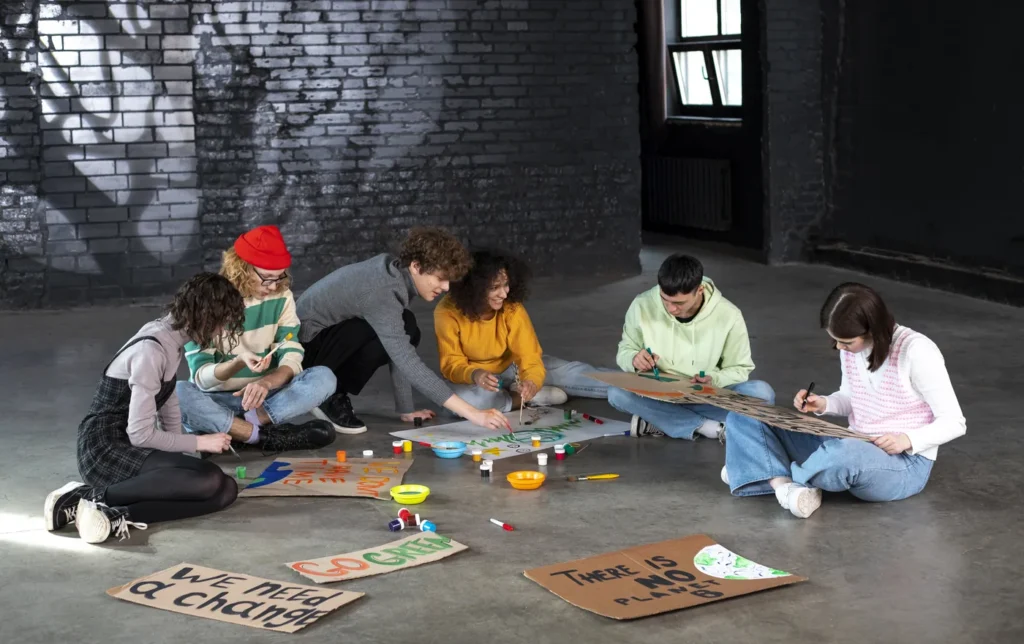
Group making posters together on the floor

The newspaper sculpture

In subgroups, using newspapers and masking tape, you build a sculpture that tells a story. Then each group presents it, carrying on from the previous group’s sentence.

Subgroups of 4 to 6 · 20–30 min · Newspapers and masking tape

The key: few materials and a short time. That way nobody just stands there watching.

The advert

Three people get a product to sell from the group and a role each: the celebrity customer, the technician and the person who uses it at home. They improvise the advert.

Trios, with an audience · 15–20 min · No materials

The key: the group suggests the topic; the performers only have to say yes.

4

Trust and closing

For when the team has already warmed up.

Team high-fiving in a meeting

Roses and thorns

In a round, everyone shares a rose, something good about this period, and a thorn, something that’s been hard.

Up to 12 per round · 15–20 min · No materials

The key: the facilitator goes first, and their example sets how much people share.

Blind portrait

In pairs, each person draws the other’s face without lifting the pen or looking at the paper. First for three minutes; then with the other hand; finally, in fifteen seconds.

In pairs · 10–15 min · Paper and pens

The key: nobody draws well like this, and that’s the fun of it. Inspired by the work of Segni Mossi.

To make them work

Five facilitator principles

The same exercise can go perfectly or feel awkward depending on how it’s run.

When it’s worth bringing in someone from outside

When there’s tension in the team, when there are a lot of you or when the leader wants to play as one of the group.

See Team Building → Guide: what team cohesion is →

1

Build up gradually

Start with what exposes people little. The personal stuff comes last.

2

Short instructions and an example

If you have to explain it twice, it’s too wordy.

3

Taking part is voluntary

Those who prefer to watch are still part of the group.

4

The facilitator plays too

If you stay on the sidelines, the group notices.

5

One word to close

Final round: the word each person takes away.

FAQ

Questions before trying them

Between 5 and 30 minutes. One is enough for a team meeting; a full session links several over 90 to 120 minutes.

Yes. “Two truths and a lie”, “Yes, and…” and “Roses and thorns” work on video calls. We’ve run online team cohesion workshops.

Taking part is voluntary. Start with exercises that expose people little and let everyone join in at their own pace.

A group exercise is a one-off activity. Team Building for companies is a session designed around a team goal, with several linked exercises and a facilitator.

From page to room

If you’d rather we ran it

We design the session for your team and run it at your office, hotel or venue.

✓

Request received!

Thank you for telling us about your group. We’ll reply within 24 working hours with a tailored proposal.

Want to share more details or would you rather talk?

Three steps, one minute

Tell us about your group

We’ll help you shape the experience around your needs.